
Hummingbird
A personalized friendship matchmaking service for more meaningful connections
Duration: 3 months
Role: Co-creator, experience designer, interviewer, matchmaker
Reach: ~100 users, 5 curated matches
Romantic love gets all the cultural infrastructure: dating apps, dating shows, the social acceptance and expectation that it will be pursued with real effort. We write poetry and music and dedicate our lives to romantic love while other forms of love recede into the background. Few of us honor the friend who stays up all night with us bingeing Netflix, the friend who takes care of us at the hospital, the friend who holds us when we cry.
My own views on friendship shifted after forming a few close, life-defining friendships, including the loss of one. “It’s your friends who break your heart,” and Esther Perel calls friendship “its own unique love story.”
In a loneliness epidemic, we’re seeking more than romantic love. We want to feel deeply connected. We want friends who feel like home.
That’s why we built Hummingbird.
The Premise
People are starving for connection and the evidence is everywhere. Not just because it’s been declared a public health crisis, but it is also physically all around us: posters to “meet a neighbor,” social clubs promising new friends, countless apps designed to accelerate connection.
A friend and I created Hummingbird to go further: one-on-one, personalized friendship matchmaking, completely free.
We weren’t looking for happy-hour buddies or someone to fill time with. We wanted to create something more durable: someone who shares your values, mirrors your life stage, or is navigating similar terrain.
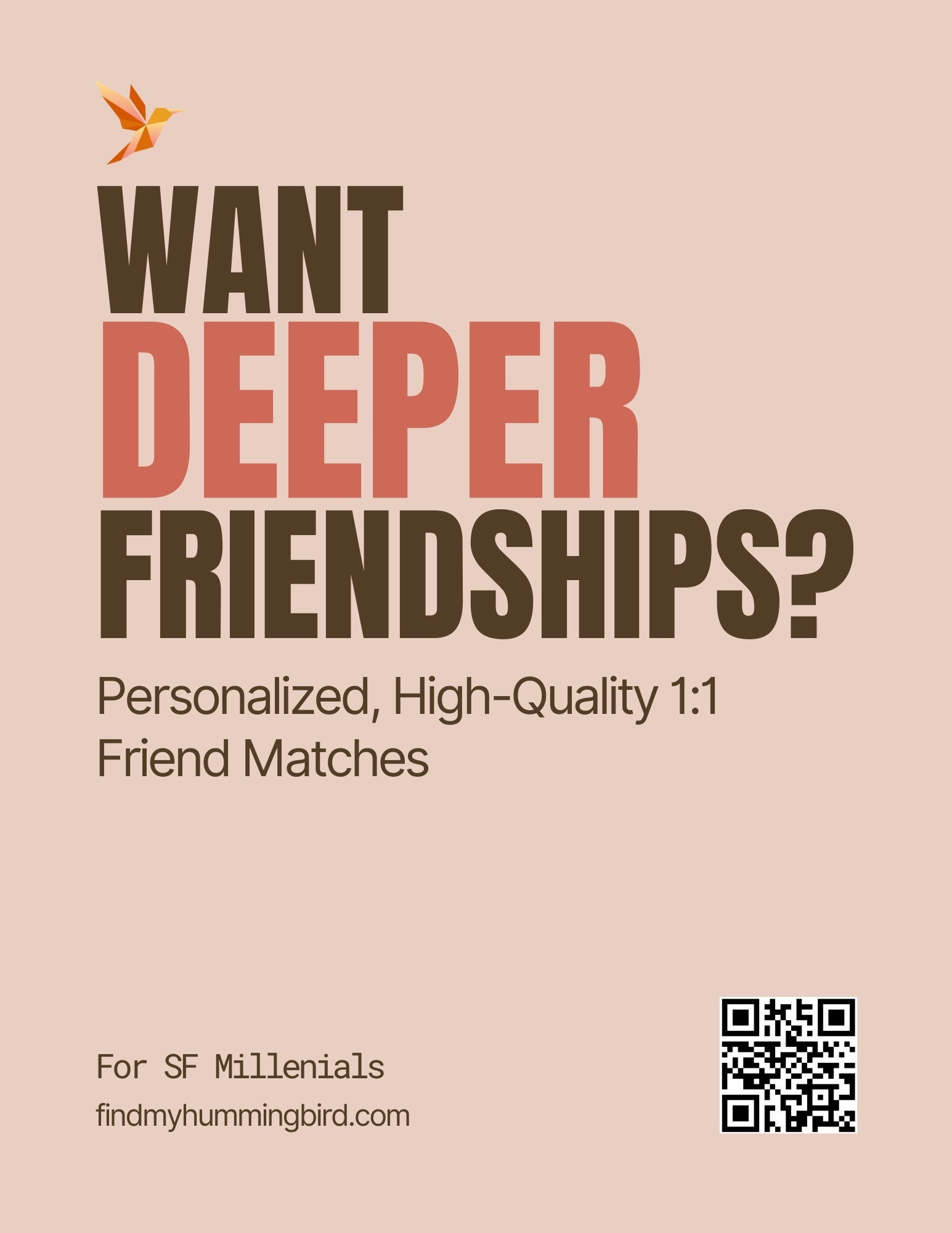
With minimal marketing—posters around town and a few LinkedIn posts—we reached over 100 users in just three months. That response validated both the problem and the hunger for a solution.
The Design
No profiles. No swiping. No awkward intro chats. We deliberately stayed away from the dating app paradigm.
We built a two-part intake process, including a questionnaire and an intro meeting, to reduce gamification and get past the surface. Once we gathered enough information, we built a profile for each user and started matchmaking. When we made a match, we shared exactly why we matched them, so they’d walk into their first meeting with meaningful conversation starters.
I’ll share the in-depth process below.
Stage 1: The Questionnaire
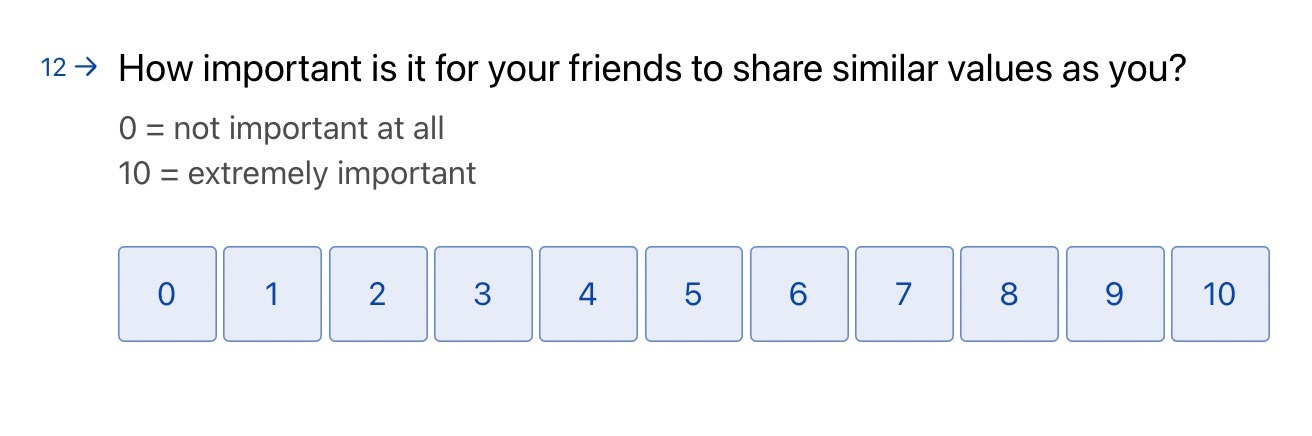
Everyone interested started by completing a questionnaire. Beyond basic information about demographics and interests, we asked users to rank their top values, share their top priorities, and describe what they were navigating (e.g., career transition, health issues, breakup or divorce). We wanted to know what each person really cared about.
Stage 2: The Meet-and-Greet
The questionnaire gave us a strong foundation, but we needed more details to build a rich profile for each person. After completing the survey, users were invited to a one-on-one video call with us, which was required before entering our match pool.
In the meet-and-greet, we dug into the survey responses. We asked questions like “How do you define a close friendship?” and “What’s something a friend did that you really appreciated?”
My favorite part? People got vulnerable. They opened up about personal struggles: health issues, family estrangements, financial hardship. They shared about things that lit them up: one person talked about their dedication to helping friends succeed professionally. These conversations were energizing and connecting, and I felt honored to hear such a diverse spread of stories across San Francisco.
In each call, we were upfront about our matching philosophy: it could take longer than expected, and we’d only make a match if we were confident it would create a meaningful connection. This also meant not everyone made it into our match pool. One person signed up wanting romantic matches, another wanted casual weekend friends. We left those folks outside our pool, confident they’d find other services to help them with what they’re looking for.
Stage 3: The Matchmaking
Once we gathered enough information from the questionnaires and intro meetings, we built rich profiles for each user with summaries, personality notes, and other keyword tags. Then came the exciting part: the matchmaking.
My co-creator and I debated each pairing: would they make a good match, why or why not? We also used ChatGPT to cross-reference meeting transcripts to help surface compatibility indicators we might have missed. Though it generated a lot of potential pairings, I didn’t personally agree with many of them. Where I could pick up tone, energy, and relational texture, AI could only pattern-match based on text. This gap in algorithmic matching turned out to be my favorite takeaway from the project (more on that below).
When we landed on a match, we introduced the pair and explained why we put them together. From there, they were on their own. We checked in to make sure they’d met and sent out post-match surveys.
The Outcome
Out of the 100+ users who signed up and filled out the questionnaire, over 50 completed the meet-and-greet requirement while the rest filtered themselves out. Then, from those 50, we made 5 matches based on strong compatibility signals.
None of the matches became best friends, as far as I know, and a few connections faded after the first or second meeting. Still, we heard positive feedback and people wanted more matches.
Future Iterations
After three months, we put Hummingbird on pause due to shifting personal priorities. However, if I were to strategize for a v2, here’s what I’d explore next.
An AI interviewer. The single most time-consuming element was conducting the 30-minute meet-and-greet video calls and we can’t scale if we have to personally manage every single meeting. I was skeptical of AI interviewers until I chatted with Boardy, a LinkedIn connector. I expected it to be awkward and robotic, but Boardy was warm, perceptive, and the conversation flowed naturally. It completely changed my thinking, and I’d definitely invest in testing an AI interviewer for Hummingbird v2.
A better matching framework. A lot of matching was based on vibes. And…what does that even mean? Our process leaned subjective, and a v2 may benefit from a more explicit, objective matching rubric. Except, could a more objective system really generate better matches? This leads me to my takeaway below.
Lessons and Revelations
The best part about the project was watching an innocuous idea crystallize into a tangible service. “We’re live!” was a genuine high point. Building Hummingbird meant wearing every hat—experience designer, marketer, interviewer, matchmaker, and more. I especially enjoyed designing the user journey, from the moment someone signed up to the moment they received a match. I loved that it was a deeply human-centric experience.
I also appreciated the design questions it raised: What do we ask to get a fuller picture of someone? How do we uncover the motivation beneath the surface? How do we make intentionality feel warm instead of overbearing?
Playing matchmaker made me feel powerful, and the work itself felt audacious. We made matches based on our best interpretations of the people we interviewed, and even though we collected meaningful information, it still only captured one side of a complex, multifaceted human being.
Final Takeaway
The secret about matchmaking? It doesn’t work. Yup. That’s what I said. It doesn’t work—at least not reliably. And in the instances that it does work, I think it’s mostly luck.
Now, I’m not disproving my work. I loved building Hummingbird and I think we identified a real problem worth solving. But you simply cannot predict two people’s chemical reaction no matter how much data you collect. I know because I’ve seen this. Two people who seemed like they wouldn’t get along became best friends. “Similar” people got together and never clicked.
What makes sense on paper is a complete toss-up the moment two people come face to face, because connection can’t be analyzed by an algorithm—it is felt. An LLM may have all the right words, but it doesn’t know how a genuine connection feels.
The concept of matchmaking is perhaps well-intentioned, but I don’t believe there’s any formula that can “crack” human connection. In an era defined by AI, while I’m fascinated by the technology, I’m also relieved that the experience of being human cannot be taught—it must be lived.